In my previous article, I reviewed Ajishirabe(味しらべ) as the “rival to Happy Turn (ハッピーターン).”
So, you might be wondering—what exactly is the difference between these two iconic snacks?
To give you the full picture, I’m breaking this comparison down into a 3-part series!
In this first part, I’ll start with “Origins & Branding.” I’ll dive into the secret stories behind their names and the clever marketing strategies hidden in their packaging!
Note: Labeling these two as “rivals” is purely my personal opinion based on their similar flavor profiles. There is no official rivalry or conflict between the manufacturers, Kameda Seika (亀田製菓) and Iwatsuka Confectionery (岩塚製菓) 😆
Launch Year
First, let’s look at which one hit the shelves first.
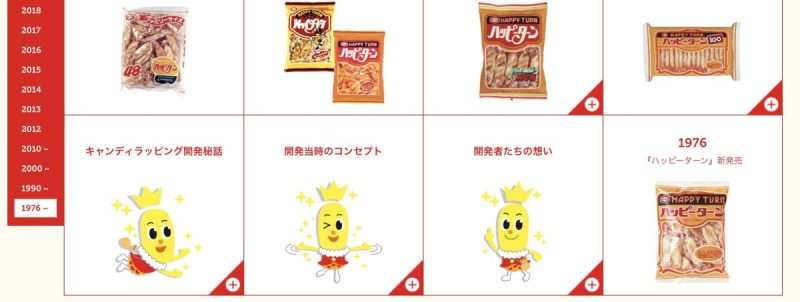
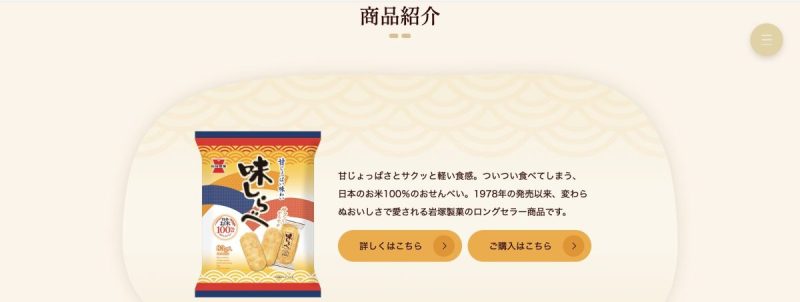
According to the official websites, Happy Turn was launched in 1976, and Ajishirabe followed in 1978. That makes Happy Turn just a couple of years older.
Honestly, rather than worrying about which came first, I’m just blown away by the fact that they’ve both been around for half a century! 😆
The Origin of the Names
Why were they named Happy Turn and Ajishirabe? Let’s take a look at the stories behind each name.
Happy Turn
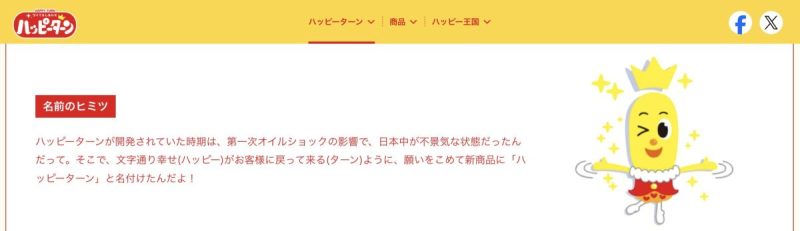
The period when Happy Turn was being developed was a time of economic recession throughout Japan due to the first oil shock.
Therefore, the new product was named ‘Happy Turn’ with the wish that happiness would literally return (turn) to the customers.
Ajishirabe
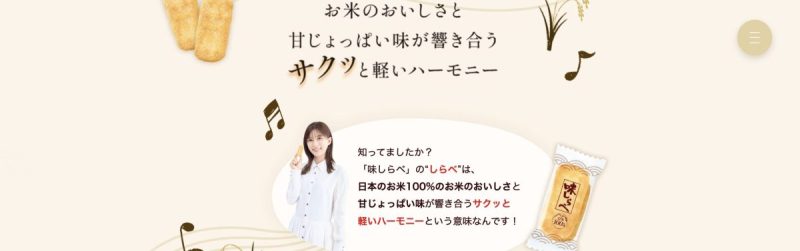
The ‘Shirabe’ in Ajishirabe signifies a crisp, light harmony where the deliciousness of 100% Japanese rice and the sweet-and-salty flavor resonate together.
As you can see, both names are filled with either the historical background of the era or a deep commitment to the product itself! ✨
Popularity and Availability
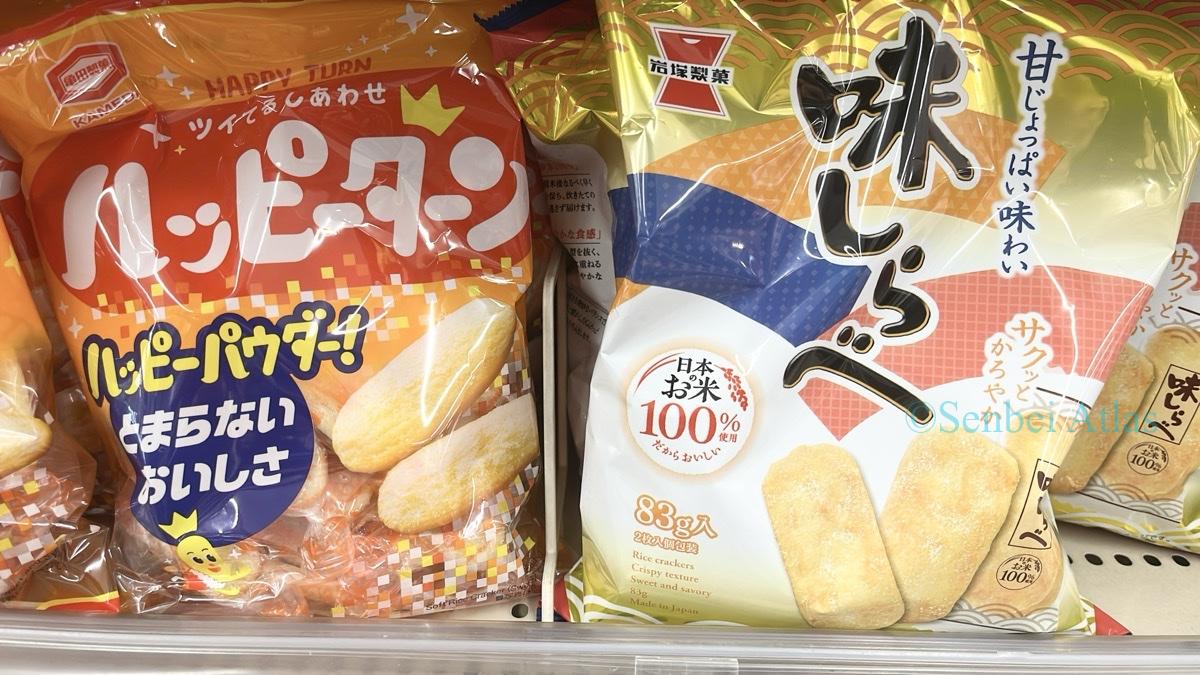
When it comes to popularity, the winner is Happy Turn!
It is so incredibly famous that it’s hard to find anyone in Japan who doesn’t know it.
On the other hand, Ajishirabe is a “hidden gem” cherished by those in the know.
Since Happy Turn has such high brand recognition, it’s available at a wide variety of locations, including convenience stores, making it very easy to buy.
In contrast, Ajishirabe isn’t quite as famous as Happy Turn, so you won’t find it everywhere; its main “battleground” is the supermarket shelf.
Happy Turn seems to have established a perfect “Infinite Loop” ♾️: High recognition → Consistent sales → High demand from stores → Even higher recognition and more sales → Even more stores stocking the product.
Of course, the absolute prerequisite for this loop is that the snack must be “delicious.” However, there’s no doubt that the sheer power of “brand recognition” makes this cycle incredibly strong.
On the other hand, Ajishirabe continues to be loved by steadily growing its solid fan base, even without relying on that kind of loop.
It is fascinating to see how these two snacks have such different sales approaches! ✨
Packaging and Brand Imagery
A look at their packaging and official websites reveals completely different brand strategies and target audiences!
Happy Turn
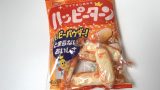
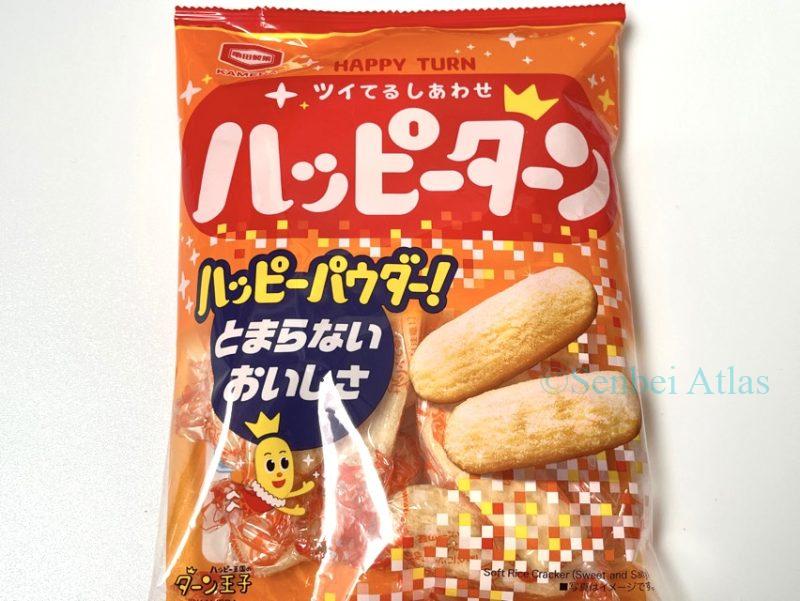
The packaging features a bright orange base, casual fonts, and an original character for a pop, energetic design. It creates a fun and cheerful image.
The official website matches this vibe, projecting a bright and lively impression, and even features children.
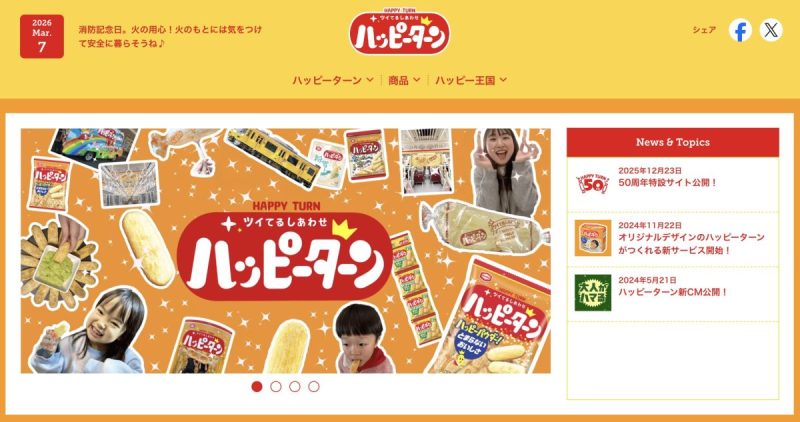
It gives the strong impression that Happy Turn targets families and the younger generation with its approachable, upbeat image.
Ajishirabe
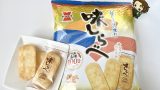
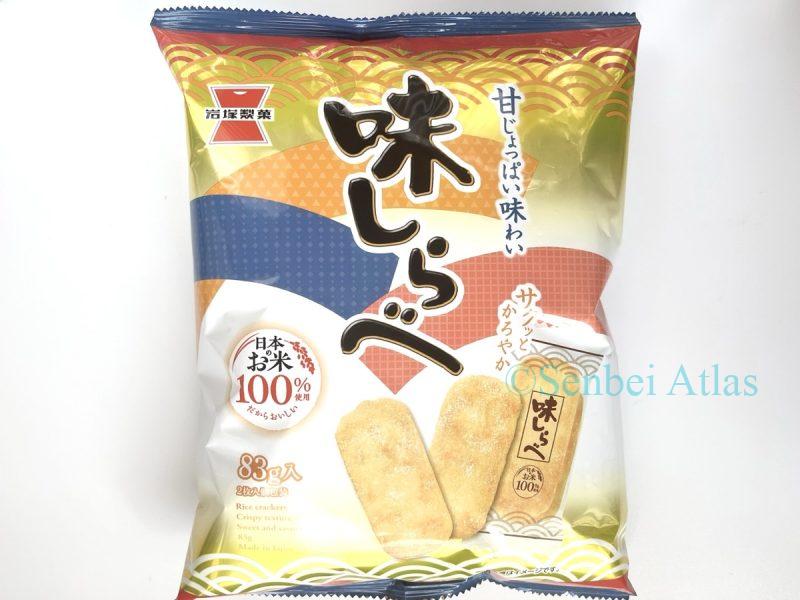
In contrast, Ajishirabe features a very calm and sophisticated package, with traditional Japanese patterns and a classic, understated font.
The official website features a clean, refreshing main visual of a woman with her hair tied back, set against a background of lush green trees.
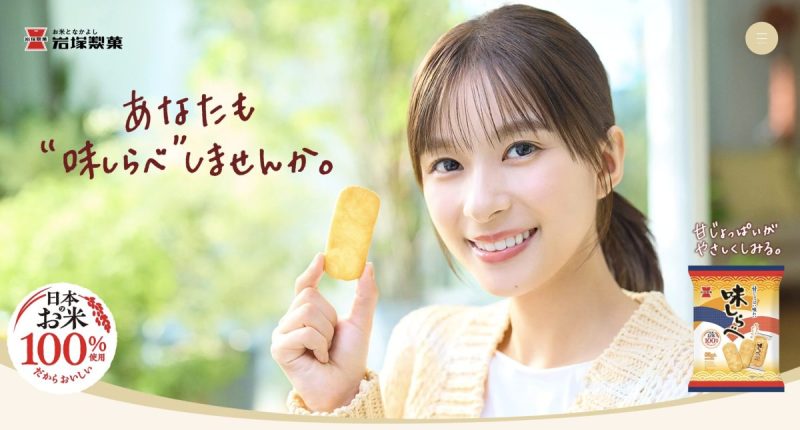
The key detail to notice here is that she is “completely unadorned.”
She wears natural-looking makeup, with no earrings or jewelry, and no noticeable nail polish. This creates an impression of pure “naturalness.” 🌱
Her outfit is casual everyday wear, and a major point is the pastel-colored, chunky knit cardigan—a classic symbol of a “gentle and kind impression.”
The handwritten-style text (“あなたも味しらべしませんか?”) also adds a sense of “approachability.”
The refreshing background, her own transparency, the chunky knit, and the handwritten script… I feel that the “cleanliness, naturalness, gentleness, and comfort” we unconsciously sense from these elements are exactly the image the manufacturer wants to project for Ajishirabe.
Since Ajishirabe is a product that insists on using “100% Japanese rice,” this impression of “being natural” (competing on the quality of the ingredients themselves) links together perfectly ✨
Additionally, with a gentle beige background and chic fonts, the overall design leaves an impression of tranquility and reliability.
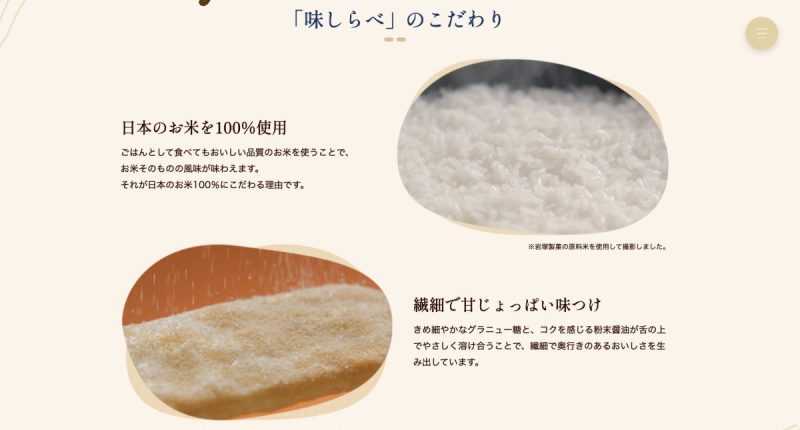
It feels as though Ajishirabe targets adults who value a sense of calm, peace of mind, and authenticity.
However, let me be clear: regardless of age, there is no doubt that both Happy Turn and Ajishirabe are incredibly delicious! 😋
What the Manufacturers Proudly Promote
Based on their packaging and official websites, here is a summary of the key selling points each brand emphasizes.
Happy Turn
Happy Turn puts its “Happy Powder” front and center, promoting the “unstoppable deliciousness of its sweet-and-salty powder.”
The focus is clearly on the addictive nature of its signature seasoning.
Ajishirabe
On the other hand, Ajishirabe places its strongest emphasis on its ingredients: “Non-glutinous rice (Uruchimai): Produced in Japan.” It highlights its sweet-and-salty flavor and a light, melt-in-your-mouth texture.
Interestingly, although Ajishirabe is covered in a rich, savory umami powder just like Happy Turn, the manufacturer doesn’t really promote the “powder” itself.
I found this strange 🤔, so I searched every corner of their official website. I finally found the answer:
“Ajishirabe was created with the concept of seasoning that enhances the natural aroma of the rice.”
This made perfect sense to me. Because their priority is the rice itself, they emphasize the “Non-glutinous rice (Uruchimai): Produced in Japan” instead of just the powder.
As mentioned in my Ajishirabe’s review, most rice crackers found in supermarkets (including Happy Turn) often use a blend of imported and domestic rice.
| Product Name | Rice Ingredients |
| Happy Turn | Non-glutinous rice (Uruchimai): Produced in USA and Japan |
| Ajishirabe | Non-glutinous rice (Uruchimai): Produced in Japan |
Finding a snack made with 100% Japanese rice at a standard supermarket price is actually quite rare.
This commitment to quality ingredients is a powerful and unique selling point for Ajishirabe.
—Now that we’ve explored the fascinating stories and branding behind these snacks, you might be wondering—what about the actual taste and texture?
How do Happy Turn and Ajishirabe truly differ from each other?
Stay tuned for Vol. 2: Tasting, where we take these two icons to the ultimate taste-test ✨
Note: All screenshots of the official websites in this article are current as of March 2026.
Check out the articles below for more details on Happy Turn and Ajishirabe!